
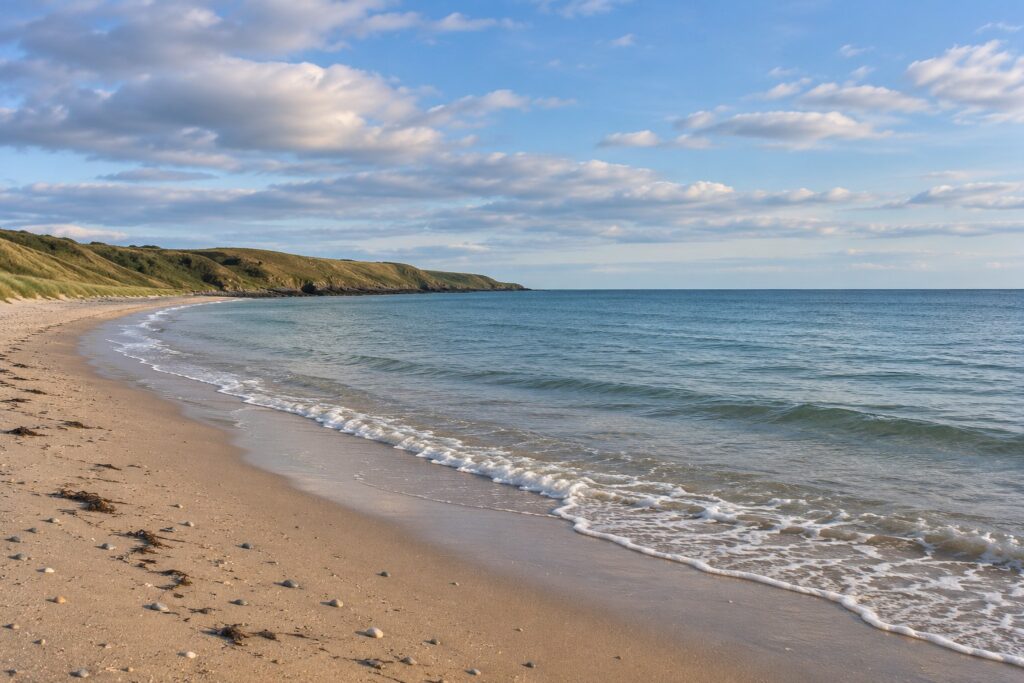
A shoreline may look compelling in person and strangely empty in a photograph. The sea stretches across the frame, the sky occupies the rest, and the feature that caught your attention feels smaller than you remember.
For stronger coastal photography composition, decide what you want the open space to do. It might give a small boat room to breathe, show the sweep of a bay or place a dramatic sky above a narrow strip of land. The horizon and shoreline are useful because they organize that space, but neither needs to follow a fixed formula.
Decide what the coast is showing you
Before choosing a horizon position, identify the relationship that makes the scene interesting. It could be a headland projecting into open water, a curved beach enclosing a quiet bay or a person whose small scale makes the coast feel expansive. Give that relationship priority when deciding what enters the frame.
Consider what each part contributes. A foreground of textured sand may explain where you are standing. A wide area of water may create distance between the shore and a boat. A blank sky may give a subject space, or it may simply reduce the size of everything else. The distinction depends on the picture you intend to make.
If you are photographing several environments during a trip, the same question changes with the setting. In a forest, for example, the challenge may be separating overlapping forms; the companion guide to finding order among trunks, leaves and branches explores that denser arrangement.
Place the horizon according to what deserves space
A high horizon gives more of the frame to the foreground and sea. Try it when a curve of wet sand, scattered rocks or the relationship between a boat and the water is more informative than the sky. Check that the extra foreground has a role: a large featureless patch can leave the subject stranded rather than give it context.
A low horizon gives the sky more room. This can work when cloud shapes, color or a large area of quiet space contribute to the mood. If the sky has little variation, compare a tighter frame that gives more attention to the coastline. Neither choice is automatically stronger.
A centered horizon can be useful when the division itself is the point, especially when land or a reflection creates a balanced arrangement above and below it. Move the horizon away from the center when one half feels more important. Think of familiar guides such as thirds as starting points for comparison, not positions you must obey.
Make two versions from the same spot: one with more sky and one with more sea or shore. When you review them, ask which version makes your intended subject easier to notice. This comparison is often more useful than deciding on a horizon position before looking at the scene.
Use the shoreline as a shape, not just a leading line
A shoreline can carry the eye through a frame, but its direction and destination matter. A curve that starts near the lower edge and bends toward a headland can connect foreground and distance. A diagonal that exits immediately through the side may instead pull attention away before the viewer reaches the subject.

Look at where the visible edge begins, bends and leaves the frame. You may be able to shift a little along a permitted path or viewing area so the curve has room to develop. Changing camera height can also alter how much foreground separates the shoreline from the bottom edge. Compare the entire arrangement after each move: improving the curve may place an unwanted object behind your subject.
A straight shoreline does not need to become a dramatic curve. It can divide areas of contrasting tone or create a calm horizontal structure. A broken edge, interrupted by rocks or vegetation, may describe the character of the place more clearly than a smooth line. Keep the irregularities that help explain the coast rather than cleaning every one away.
Imagine a bay with a small headland at one end. From one position, the beach forms a diagonal that points toward it; from another, the beach occupies most of the lower frame and the headland becomes an afterthought. Choose the first if the connection matters, or the second if the shape of the beach is the subject.
Balance foreground, water and distant land
Foreground gives the viewer a place to enter the photograph, but it needs to relate to what lies beyond. A rock can echo the shape of a distant island; a strip of sand can show the curve of a bay. If a large foreground object hides the shoreline or competes with your main subject, move the camera or leave it out.
Watch the gaps between elements. A boat separated from the distant shore may read clearly, while the same boat overlapping a dark headland can become harder to recognize. A small sideways change in position can open that gap. Changing focal length from the same position changes framing, but it does not create the same change in overlap.
A wider view can include the relationship between foreground, sea and coast, provided each part earns its space. A tighter frame can isolate a headland against open water or remove distractions at the edges. Neither view is inherently more descriptive: include enough surrounding space for the subject to make sense.
When the scene feels crowded, inspect the edges before taking the photograph. A partial rock, a sliver of beach or a cut-off boat may demand attention without adding context. Reframe deliberately, or leave enough room to make the object part of the composition.
Keep the horizon intentional
An uninterrupted sea horizon is a strong visual reference. If it appears slightly tilted, that tilt may draw attention away from the rest of the picture. Use a grid or level display if your camera offers one, then check the result against the actual horizon rather than against a sloping beach or headland.
The visible edge of a coast is not always the horizon. A bay, island or rising landform can make part of the distant boundary slope naturally. Level the photograph using a clear section of sea horizon when available; do not force a landform to look horizontal.
If you straighten an image later, the resulting crop can remove details near the edges. Leave a little room around a shoreline curve or subject when you can, and check that the corrected frame still holds the relationships you intended. A deliberate tilt can work too, but consider whether it adds a useful sense of movement or merely makes the sea look unsettled.
Work with the conditions in front of you
Light can change which part of the coast holds attention. Side light may reveal texture on sand or rock, while softer light can make the broad shapes of land and water easier to compare. If a bright patch competes with the headland or person you want to emphasize, try changing the frame or waiting to see whether the balance improves.
The waterline is not fixed within your composition. Watch a few waves from a safe position and notice where their edges reach. A receding line of foam may briefly connect foreground and sea; a larger wash can cover the sand pattern you wanted. Make frames at different moments and choose the arrangement that supports the photograph. For a broader treatment of motion rather than composition, see the planned guide Photographing Water in Motion: Texture, Streaks or a Smooth Surface?.
Keep your attention on the surroundings as well as the frame. Stay within permitted areas, leave room for other people and choose a position where you can observe changing water and footing. If a better angle would require moving into an exposed or restricted place, look for another composition from a suitable viewpoint.
Compare the pictures by their purpose
Before leaving a promising viewpoint, make a small set with clear differences: a wide view showing the shape of the coast, a frame that gives the shoreline a stronger role, and a tighter view of one relationship between land and sea. These are alternatives, not a required shot list. Stop when the differences no longer serve a purpose.
On review, look at each photograph as a whole. Does the horizon give enough space to the part that matters? Does the shoreline connect elements or pull attention out of the frame? Is the foreground helping you understand the scene? Keep the version whose proportions make your original idea clearest, even if another follows a more familiar compositional convention.